
On this page
Choose GLOW if you want BPC-157, TB-500 and GHK-Cu together without anything else in the vial, and choose KLOW if your study also needs the tripeptide KPV. Both are listed at $169.99, so KLOW gives you 80mg of material against GLOW’s 70mg, and the only real question is whether an extra 10mg of KPV helps your design or gets in its way.
This buyer’s guide covers what is in each vial, how to decide between them by type of in-vitro work, which one suits method development versus a full run, and what the same material would cost as single vials.
Decide by what your cell-culture work needs
| If your study involves | Order | Because |
|---|---|---|
| A combined BPC-157 + TB-500 + GHK-Cu material with no fourth component | GLOW 70mg | Three compounds give fewer variables and fewer peaks to assign |
| NF-κB or cytokine-pathway readouts in epithelial or immune cell lines | GLOW 70mg, unless KPV is a deliberate arm | KPV is itself studied against these pathways and could confound the result |
| The same three compounds plus a melanocortin-derived tripeptide | KLOW 80mg | KPV comes pre-combined at 10mg |
| Comparing three-component and four-component blends side by side | One of each | The only difference between them is the KPV |
| Any work that needs each compound alone as a control | Single vials alongside the blend | A blend cannot supply its own reference arms |
See what goes into each vial
| Component | Molar mass (PubChem) | GLOW 70mg | KLOW 80mg |
|---|---|---|---|
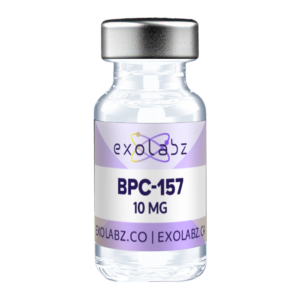
| BPC-157 (15 residues) | 1419.5 g/mol | 10mg (≈7.0 µmol) | 10mg (≈7.0 µmol) |
| TB-500 fragment (Ac-LKKTETQ) | 889.0 g/mol | 10mg (≈11.2 µmol) | 10mg (≈11.2 µmol) |
| GHK-Cu (1:1 copper complex) | 402.9 g/mol | 50mg (≈124 µmol) | 50mg (≈124 µmol) |
| KPV (Lys-Pro-Val) | ~342.4 g/mol | none | 10mg (≈29.2 µmol) |
| Total | 70mg | 80mg | |
| List price (USD) | $169.99 | $169.99 |
The mass labels hide how lopsided these blends are in molecular terms. GHK-Cu is five times the mass of either larger peptide and far lighter per molecule, so in GLOW it accounts for about 87% of all the molecules present. In KLOW, KPV becomes the second most abundant species by moles, ahead of both BPC-157 and TB-500, even though it is only 10mg. Keep that in mind if your readout is sensitive to molar concentration rather than to mass.
Weigh the analytical workload
Each extra component is another identity to confirm. For GLOW, a lab verifying the vial needs to find three species: two peptides roughly 530 g/mol apart and a small copper complex. KLOW adds a fourth, the tripeptide KPV, which is close in size to the GHK part of GHK-Cu. Because GHK-Cu is present at five times the mass of BPC-157 or TB-500, a single chromatogram has to accommodate a large peak next to much smaller ones, so method development usually takes longer on either blend than on a single peptide. The general issues are covered in our guide to purity and composition in multi-peptide blend vials.
For component-level detail, see the GLOW blend composition analysis, the KLOW component research overview, how copper is coordinated in GHK-Cu and KPV tripeptide identity analysis.
Know the in-vitro literature behind each component
- BPC-157: a 15-residue sequence that appears in published cell-culture studies of cell migration and growth-factor-receptor expression.
- TB-500 fragment: the actin-binding motif of thymosin β4 (residues 17 to 23), studied for G-actin interaction. It is not the full-length protein, as explained in thymosin β4 versus the TB-500 fragment.
- GHK-Cu: a copper(II) complex of the tripeptide Gly-His-Lys, studied in fibroblast cultures for extracellular-matrix gene expression and for its copper-binding chemistry.
- KPV: the C-terminal tripeptide of α-MSH (Lys-Pro-Val), examined in epithelial and immune cell-line models in relation to NF-κB signaling.
These descriptions reflect published laboratory literature only and describe no outcome beyond it.
Pick a blend for method development or a full run
Both blends come in one size, so the decision on vial size is really a decision on whether to buy a blend at all at the start. For method development on a single component, a single vial is cheaper and simpler: GHK-Cu 50mg is $59.99, and BPC-157 5mg is $56.99. Once your method separates every component, a GLOW or KLOW vial holds a full run’s worth of fixed-ratio material on one lot. If the run will be split over several sessions, read our storage and stability guide for lyophilized peptides first.
Compare the cost per milligram
| Option | Price (USD) | Arithmetic | Cost per mg |
|---|---|---|---|
| GLOW Blend 70mg | $169.99 | 169.99 ÷ 70 | $2.43 |
| KLOW Blend 80mg | $169.99 | 169.99 ÷ 80 | $2.12 |
| GLOW’s contents as singles: BPC-157 10mg + TB-500 10mg + GHK-Cu 50mg | $250.97 | (90.99 + 99.99 + 59.99) ÷ 70 | $3.59 |
Buying GLOW’s three components as separate vials costs $80.98 more than the blend, but it lets you vary the ratio and run each compound on its own. KLOW has the lowest cost per milligram of the three options because the KPV comes at no extra list price. That only counts as value if KPV belongs in your design. For how to compare fairly across vial sizes, see comparing research peptide prices per milligram.
Plan your US order
Orders ship domestically from Utah, leave within one business day and usually arrive in two to five days. One GLOW plus one KLOW comes to $339.98 and ships free, since the free-shipping threshold is $200. Quantity pricing is applied in the cart. Both blends are 99%+ purity and third-party tested with HPLC and purity testing. Certificates for some products appear on the COAs page, and every vial is matched to its certificate by cap and crimp color.
FAQ
What is the difference between GLOW and KLOW?
KLOW contains everything in GLOW (BPC-157 10mg, TB-500 10mg, GHK-Cu 50mg) plus 10mg of KPV, giving 80mg in total against 70mg.
Why are GLOW and KLOW the same price?
Both are listed at $169.99. As a result KLOW works out cheaper per milligram, at $2.12 against $2.43.
Is KLOW always the better buy?
Only if your study needs KPV. If KPV could interfere with a pathway you are measuring, GLOW keeps the design cleaner.
Is the TB-500 in these blends full thymosin beta-4?
No. It is the acetylated seven-residue fragment Ac-LKKTETQ, about 889 g/mol.
Can I verify each component in the vial?
Yes, with a method that resolves all three or four species. Expect GHK-Cu to dominate by mass and by molar amount.
What should I add to the cart if I need reference standards too?
Pair the blend with single vials of the components you must confirm. A GLOW with a GHK-Cu 50mg and a BPC-157 5mg totals $286.97, which clears free shipping and gives you separate references for the two components that are hardest to resolve against each other.
For more pairings, see the peptide comparisons hub or the related BPC-157 vs TB-500 guide.
For laboratory research use only. Not for human or veterinary use, and not a drug, food or cosmetic.
Built for labs that check the data
Dispatched usually within 1 business day as a tracked domestic parcel, 1 to 4 business days to most of the lower 48.
Independent labs test purity. Certificates are published on product pages and our certificates page, matched to vials by cap and crimp colour.
If your own third-party test shows a purity failure, the product is refunded and the test cost reimbursed.
No customs, no import duty, no brokerage. Quantity discounts apply automatically in the cart.
Live chat and email at support@exolabz.co, with replies in about an hour, day or night.
Encrypted checkout, discreet protective packaging, and orders released only to the named purchaser.
Popular research compounds
5.0 out of 5 from 25 reviews
Quick packaging and shipping !
Have tried other suppliers. Exolabz is hands down the best at communication and ease of ordering and tracking my order
Yes everything was great. I appreciated the little plastic bottle holders also
Research-grade compounds, shipped from inside the USA.
Free tracked shipping over $200, dispatch usually within 1 business day, and third-party HPLC and purity testing.