
On this page
Most questions we get about BPC-157 from US laboratories come down to three: which vial size makes sense, whether to take the blend or two separate vials, and how to tell from the certificate that the material is what the label says. This page takes those in order and finishes with the practical side of ordering within the United States.
The molecule in one paragraph
BPC-157 is a synthetic peptide of fifteen residues, Gly-Glu-Pro-Pro-Pro-Gly-Lys-Pro-Ala-Asp-Asp-Ala-Gly-Leu-Val, with a calculated monoisotopic mass close to 1,419 Da. It carries no cysteine, no methionine and no aromatic residue, which has two analytical consequences: there is nothing in it to oxidise easily, and there is nothing in it that absorbs at 280 nm. The triple proline at positions 3 to 5 is the structural feature to remember, because it is responsible for the peak broadening discussed below. The literature behind the compound is thinner than its reputation suggests; BPC-157 and the limits of the published literature lays out what has and has not been independently replicated.
Which vial
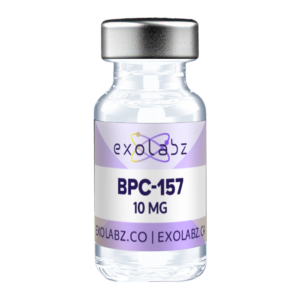
- BPC-157 5 mg for method development, where a vial will be opened repeatedly and a smaller mass limits what is exposed each time.
- BPC-157 10 mg once the working quantity is known; the larger vial costs less per milligram.
- BPC-157 and TB-500 blend, 10 mg (5 mg of each) and 20 mg (10 mg of each), co-lyophilised at a fixed 1:1 mass ratio.
On the blend question: equal masses are not equal molar amounts. The TB-500 fragment is about 889 Da and BPC-157 about 1,419 Da, so a 1:1 blend by mass holds roughly 1.6 TB-500 molecules for every BPC-157 molecule. If the ratio is a variable in your design, separate vials give you control over it; if the ratio is fixed by the protocol, the blend saves a reconstitution. Our comparison page BPC-157 vs TB-500 covers the two compounds side by side, and blend composition analysis covers what a two-component certificate should contain.
Three things to check on the certificate
- Observed mass against calculated. The report should state both, and they should agree within a few daltons of 1,419. A deletion sequence missing one proline sits 97 Da lighter; a missing glycine, 57 Da lighter. These are the typical synthesis-related impurities for this sequence.
- Detection wavelength. BPC-157 has no chromophore beyond the peptide bond, so purity must be measured at 210 to 220 nm. A certificate quoting 280 nm for this compound is reporting a number that cannot see most of what is in the vial.
- Peak shape. The three consecutive prolines interconvert between cis and trans conformers on the timescale of a chromatographic run, which can broaden or split the main peak. A broad main peak on a BPC-157 chromatogram is not necessarily an impurity. Proline cis-trans peak broadening explains how to tell the two apart.
Two adjacent aspartates at positions 10 and 11 are also sites for isoaspartate formation in solution, which does not change the mass and is only visible as a retention-time shift. Our guide to reading a certificate of analysis goes through the whole document line by line.
Handling after reconstitution
Lyophilised BPC-157 is stable at minus 20 °C and tolerates ambient transit. It dissolves readily in water and in dilute acetic acid. Because of the aspartate chemistry, reconstituted stock should be aliquoted and frozen rather than kept at 4 °C for weeks, and a working aliquot should not be refrozen repeatedly. Freeze-thaw cycles and aliquoting and vial entry cover the practice.
Ordering in the USA
Orders ship domestically within the United States, so nothing passes through import processing and there is no customs hold. Carrier and service are chosen at checkout from USPS, UPS and FedEx, orders are dispatched within one business day, and typical transit is two to five days. Per-milligram pricing across the catalogue is on the price list, larger quantities are covered on the bulk orders page, and every certificate we hold is published in full on the certificates of analysis page. Vials are matched to their certificate by cap and crimp colour.
Buying guide
Where to buy BPC-157 in the USA compares vial sizes, price per milligram at each tier, certificate checks and FedEx transit by region. Other compounds are in the buying guide index.
Research use only
BPC-157 from ExoLabz is supplied as a laboratory reference material for in vitro and analytical research. It is not a drug, not a supplement, and not for human or veterinary use, and we do not provide dosing or administration information. If an independent laboratory finds a vial below its stated purity, the purity guarantee refunds the product and the cost of the test.
Built for labs that check the data
Dispatched usually within 1 business day as a tracked domestic parcel, 1 to 4 business days to most of the lower 48.
Independent labs test purity. Certificates are published on product pages and our certificates page, matched to vials by cap and crimp colour.
If your own third-party test shows a purity failure, the product is refunded and the test cost reimbursed.
No customs, no import duty, no brokerage. Quantity discounts apply automatically in the cart.
Live chat and email at support@exolabz.co, with replies in about an hour, day or night.
Encrypted checkout, discreet protective packaging, and orders released only to the named purchaser.
Popular research compounds
5.0 out of 5 from 25 reviews
It arrived as described. Packaging was professional looking and arrived in great condition
Yes everything was great. I appreciated the little plastic bottle holders also
Great product - I have purchased peptides from various different vendors and this seems to be the only one thats pure . Highly recommend
Research-grade compounds, shipped from inside the USA.
Free tracked shipping over $200, dispatch usually within 1 business day, and third-party HPLC and purity testing.