
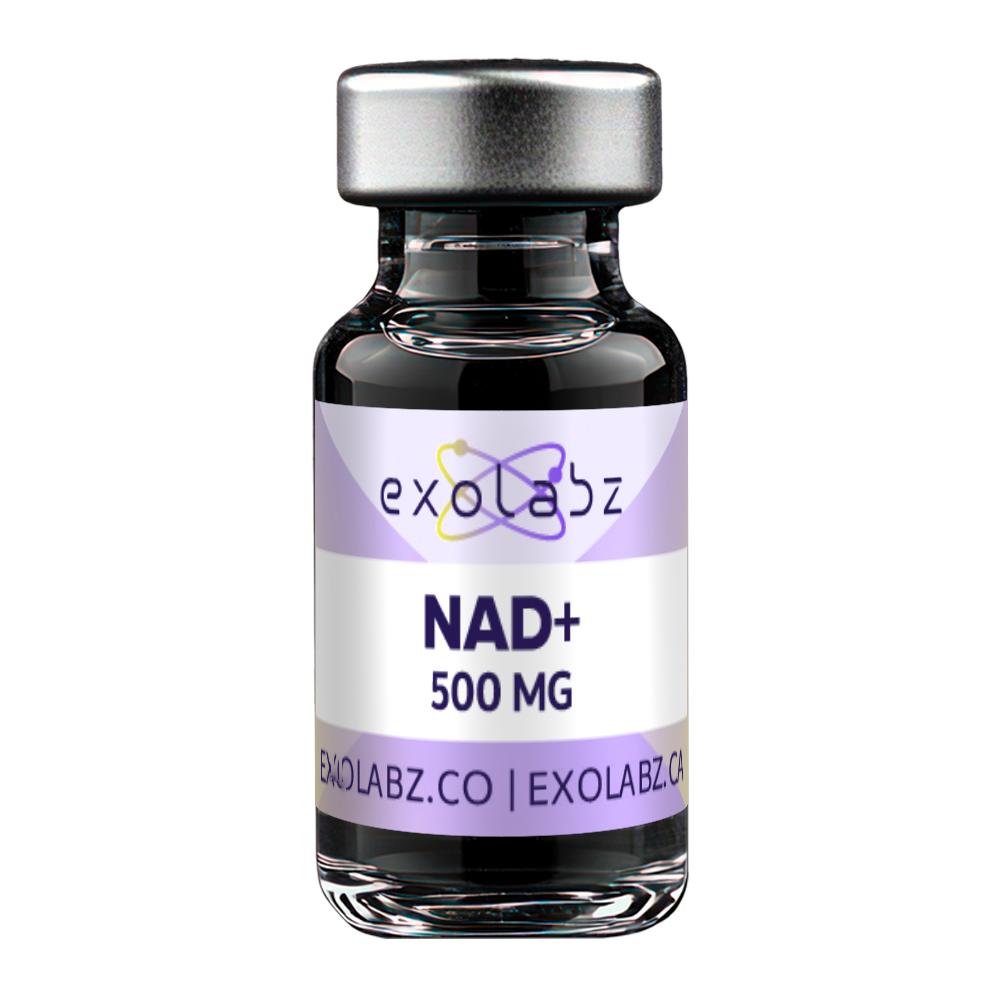
Description
NAD+ 500mg — research-grade nicotinamide adenine dinucleotide
NAD+ 500mg is supplied as lyophilized powder for in vitro laboratory research. Unlike the peptides in this catalog, NAD+ is a dinucleotide coenzyme, and it behaves differently in handling and storage — the notes below are worth reading before the vial is opened.
Ships from within the USA. Supplied for laboratory research use only, and not for human or veterinary use.
About NAD+ 500mg
Nicotinamide adenine dinucleotide is the central redox cofactor of cellular metabolism and the substrate consumed by sirtuins, PARPs and CD38. Laboratory use divides roughly into two kinds: enzymology, where NAD+ is a reagent in an assay, and cell biology, where NAD+ availability is itself the variable under study.
The oxidized form is hygroscopic and hydrolyses in aqueous solution more readily than a peptide does, particularly at alkaline pH. Prepare solutions fresh where the protocol allows it, keep the pH near neutral, and treat a stock that has sat at room temperature as suspect rather than usable.
Research applications of NAD+ 500mg
- Sirtuin and PARP enzymatic activity assays
- NAD+/NADH ratio measurement in cell and tissue lysates
- CD38 and NAD+ consumption kinetics work
- Redox metabolism and metabolic flux studies in culture
- Reagent use in coupled enzymatic assay systems
How this vial is supplied and handled
NAD+ is hygroscopic. Keep the vial sealed and frozen at -20 °C, and let it reach room temperature fully before opening so that moisture does not condense onto the powder — this matters more here than it does for a lyophilized peptide, because absorbed water starts hydrolysis in the solid state.
In solution the oxidized form degrades appreciably, and faster as pH rises. Prepare working solutions fresh where the protocol permits, buffer near neutral pH, keep preparations cold and protected from light, and aliquot anything that must be stored so that no stock is thawed twice. A yellowed solution has degraded and should not go into an assay.
Ordering NAD+ 500mg in the United States
NAD+ 500mg ships to research laboratories throughout the USA, dispatched domestically from our US facility. Every parcel is tracked, and because the material stays inside the country there is no customs entry, no broker fee and no border hold between our shelf and your bench.
Shipping is calculated at checkout and orders over $200 USD ship free anywhere in the United States. Bulk pricing is available on larger quantities — email us before checkout and we will quote it.
Purity guarantee
If an independent laboratory tests this material and reports purity below the figure stated on its certificate, we refund the order and reimburse what the test cost you. Send the lot number printed on the vial along with the third-party report and we will settle it without argument.
The guarantee covers the analysis, not the outcome of your work. What NAD+ 500mg does in your model is your experiment; what is in the vial is our responsibility.
Research use only
NAD+ 500mg is supplied strictly for laboratory research carried out by qualified professionals. It is not a drug, a dietary supplement or a medical device.
It has not been evaluated or approved by the U.S. Food and Drug Administration for any use. It is not for human or veterinary consumption, for clinical investigation in human subjects, or for therapeutic, diagnostic or cosmetic application of any kind.
We do not provide dosing, administration or protocol advice, and we cannot answer questions about use in people or animals. By ordering, you confirm that you are acquiring this material for lawful research in a controlled laboratory setting and that you will not redistribute it for any other purpose.
Compound identity and specification
Identity data for NAD+, published so the material can be checked against an independent record rather than taken on trust. The formula, mass and registry number below are verified against PubChem and can be looked up directly.
| Compound | NAD+ |
|---|---|
| Sequence | Not a peptide: nicotinamide adenine dinucleotide, a dinucleotide of nicotinamide mononucleotide and adenosine monophosphate |
| Molecular formula | C21H27N7O14P2 |
| Molecular mass | 663.4 g/mol |
| CAS registry number | 53-84-9 |
| PubChem | CID 5892 |
| Vial content | 500 mg |
| Physical form | Lyophilized powder in a sealed vial |
| Analysis | Third-party HPLC where a report has been commissioned; see the certificates of analysis page |
| Supplied for | Laboratory research use only |
Analytical note — NAD+. This is a nucleotide coenzyme, not a peptide, and peptide methods do not apply to it. It absorbs strongly at 260 nm rather than at the peptide-bond wavelength, and the relevant purity question is the ratio of oxidised NAD+ to reduced NADH and to hydrolysis products, which a peptide-style HPLC report will not address.
Identity references The molecular formula, molecular mass and CAS registry number above are taken from the PubChem record linked in the table, not from a supplier datasheet, so every figure can be checked against an independent source in one click. Sequences are given as reported in the peptide literature, in the one-letter or three-letter convention as appropriate, with any non-standard residue named in full. Where a compound exists in more than one form — a free peptide and a metal complex, a fragment and its parent protein, a modified and an unmodified analog — the form supplied is the one identified here, and the mass on the certificate of analysis is what distinguishes it.
Research Literature
Peer-reviewed studies involving this compound and its class. All findings listed are from in vitro, cell culture or animal models and are provided for scientific reference only. This product is supplied for laboratory research and is not approved for human consumption, clinical, or veterinary use.
- Canto C, et al. Cell Metab. 2012;15(6):838-847. In mammalian cells and mouse skeletal muscle and brown adipose tissue, measured tissue NAD+ levels and SIRT1/SIRT3 target deacetylation. Source · PMID 22682224
- Gomes AP, et al. Cell. 2013;155(7):1624-1638. In aged mouse skeletal muscle, measured nuclear NAD+ decline, normoxic HIF-1alpha accumulation and loss of mtDNA-encoded OXPHOS subunits. Source · PMID 24360282
- Mills KF, et al. Cell Metab. 2016;24(6):795-806. In C57BL/6N mice over 12 months, measured tissue NAD+ synthesis, cellular energetics, insulin sensitivity and skeletal-muscle mitochondrial oxidative capacity. Source · PMID 28068222
Literature notes: These studies concern NAD+ precursors (nicotinamide riboside and nicotinamide mononucleotide) rather than NAD+ administered directly.
Every certificate of analysis we hold is collected on the certificates of analysis page. Where a lot has not been independently tested we do not claim that it has.
Related Research Compounds
Browse more compounds in Mitochondrial & Cellular Compounds, or view the full research peptide catalog.

Reviews
There are no reviews yet.